
 Italiano
  English
 - On sale!


 Order support
Questions about this product? Contact us!
 Secure payment
Protected by SSL
 Express shipping
Express shipments across Europe
Our Privacy Policy explains our principles when it comes to the collection, processing, and storage of your information. This policy specifically explains how we employ cookies, as well as the options you have to control them.
Cookies are small pieces of data, stored in text files that are stored on your computer or other device when websites are loaded in a browser. They are widely used to "remember" you and your preferences, either for a single visit or for multiple repeat visits
We use cookies for a number of different purposes. Some cookies are necessary for technical reasons; some enable a personalized experience for both visitors and registered users; and some allow the display of advertising from selected third party networks.
Visitors may wish to restrict the use of cookies or completely prevent them from being set. If you disable cookies, please be aware that some of the features of our service may not function correctly
We only collect information about you if we have a reason to do so-for example, to provide our services, to communicate with you, or to make our services better.
We are committed to maintaining the trust and confidence of our website visitors. We do not collect, sell, rent or trade email lists or any data with other companies and businesses. Have a look at our Privacy Policy page to read detail information on when and why we collect your personal information, how we use it, the limited conditions under which we may disclose it to others and how we keep it secure.
We may change Cookies and Privacy policy from time to time. This policy is effective from 24th May 2018.
The vehicle chassis is one of the most heavily stressed components during performance driving. These loads are primarily generated by weight transfer during hard acceleration, aggressive braking, and high-speed cornering.
When entering a fast corner, lateral load transfer shifts a significant portion of the vehicle’s mass toward the outside wheels. In certain situations, one side of the chassis may be subjected to forces up to three times greater than the opposite side. This imbalance can lead to chassis flex, structural deformation, and torsional twist, reducing overall rigidity.
As the chassis flexes under load, suspension geometry can deviate from its optimal operating range. This affects tire contact consistency, potentially reducing grip and compromising handling precision.
Structural deformation during cornering may contribute to undesirable handling characteristics such as:
Improving torsional rigidity and minimizing chassis flex are essential to maintain predictable handling and maximize traction. Properly engineered chassis reinforcement components play a key role in enhancing stability and driver control.
During impact or under heavy lateral load conditions, part of the shock force is transferred directly to the chassis structure. This may result in deformation around the wheel housing and lower control arm mounting points, affecting suspension alignment and overall handling accuracy.
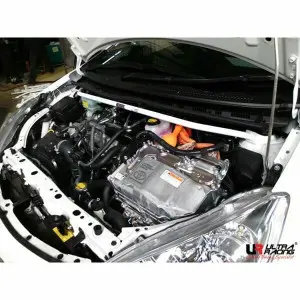
When a strut bar combined with a lower arm reinforcement bar is installed, impact forces are distributed more evenly across both sides of the vehicle.
This reinforcement reduces chassis flex and torsional movement, significantly improving rigidity and structural stability.
Under aggressive driving conditions or high lateral loads, the joint between the A-pillar and the front chassis section is exposed to substantial stress and torsional forces. Concentrated impact and drag forces can cause structural deformation and reduced stiffness.
A properly engineered Fender Bar redistributes stress across a broader structural area, reinforcing critical chassis sections and limiting excessive flex.
This improves overall structural stiffness and delivers a more stable and responsive turn-in. It is particularly recommended when upgrading to sport shock absorbers.
During cornering, lateral weight transfer causes the vehicle body to lean outward, generating body roll. Excessive roll reduces steering responsiveness and makes corner entry less precise.
An upgraded anti-roll bar significantly reduces chassis sway in corners, keeping the vehicle flatter and more controlled.
Benefits include:
The result is more predictable and confident handling, especially under performance driving conditions.

No customer reviews for the moment.